Saturday, 7 November 2026 - 16:50

About us

Gulf Mag is the first digital platform connecting the Gulf and North Africa for effective communication. We keep you up-to-date with the latest news, analysis, insights, and opportunities to connect markets, ideas, and people, and facilitate communication between entrepreneurs, communities, and influencers.


Investment opportunities

New Economic Vision Proposed to Address Libya’s Housing Crisis Through Sustainable Partnerships

Libyan businessman Hosni Bey has proposed a new housing strategy based on public-private partnerships and social rental programs instead of free ownership, aiming to provide sustainable housing solutions while protecting public resources.
Investment opportunities

New Economic Vision Proposed to Address Libya’s Housing Crisis Through Sustainable Partnerships

Libyan businessman Hosni Bey has proposed a new housing strategy based on public-private partnerships and social rental programs instead of free ownership, aiming to provide sustainable housing solutions while protecting public resources.


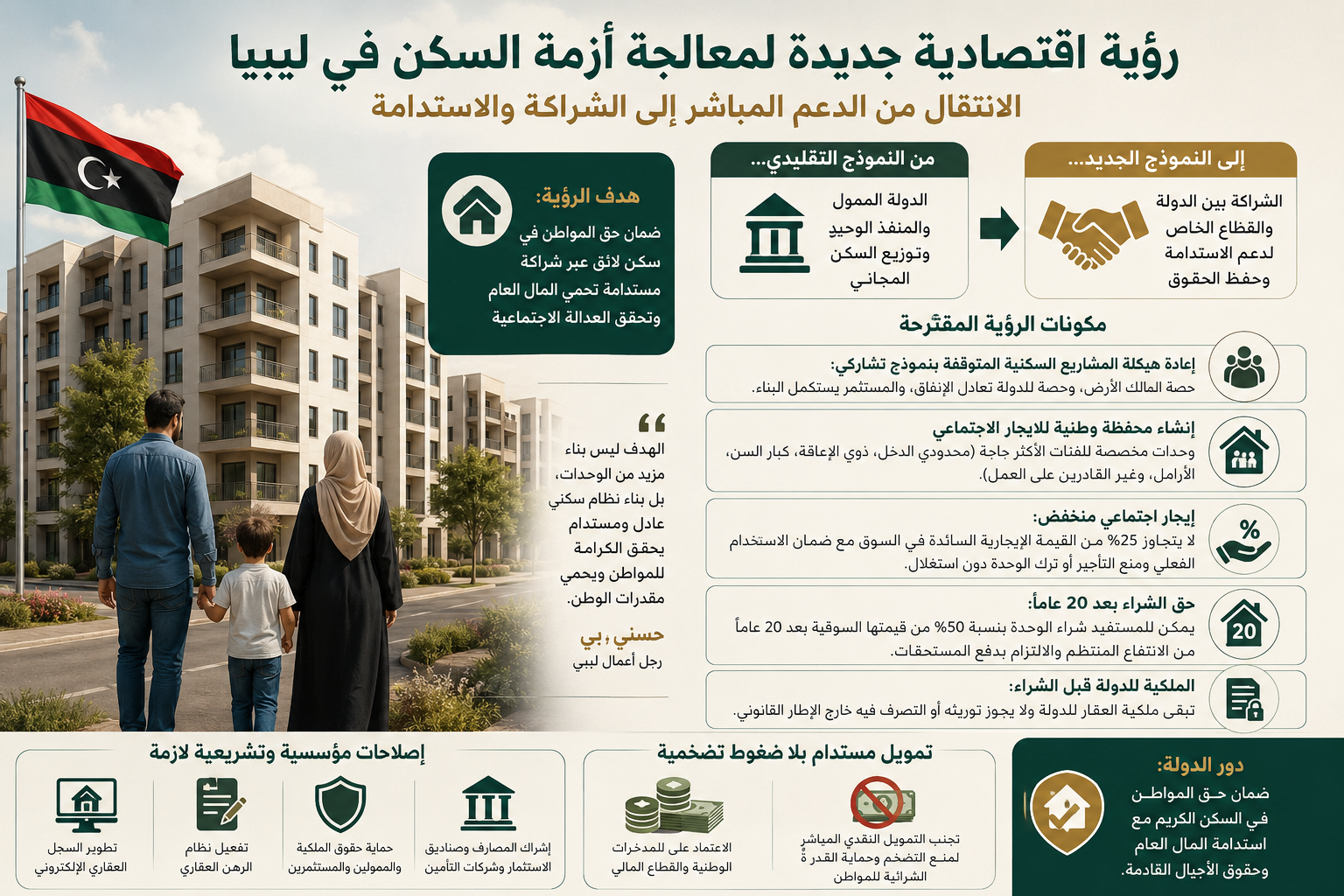
Libyan businessman Hosni Bey has proposed a new economic approach to address Libya’s housing crisis, calling for a complete reform of the country’s housing policy model and a transition from free housing distribution toward a more sustainable framework based on cooperation between the state and the private sector.

Hosni Bey argued that providing free housing for all citizens is not financially or economically sustainable, explaining that decades of reliance on this approach have contributed to stalled housing projects, frozen public funds, and the continuation of the housing shortage. He stressed that Libya needs to move away from temporary solutions and adopt realistic policies focused on efficient resource management, investment incentives, and long-term economic sustainability.

His proposal is based on redefining the role of the state in the housing sector, shifting from being the sole developer, financier, and distributor to becoming a regulator and strategic partner. He suggested restructuring stalled housing projects through partnership models that protect the interests of all parties involved. Under this approach, landowners would receive a share reflecting the value of the land, while the state would receive a separate share equivalent to its actual financial contribution. A new private investor would then complete the project and finance the remaining construction phases in exchange for the remaining share.

Hosni Bey also proposed using the state’s share to create a national social housing rental portfolio managed by municipalities or relevant social authorities. This housing stock would benefit vulnerable groups, including low-income families, people with disabilities, elderly citizens, widows, and individuals unable to work. Beneficiaries would not receive housing ownership for free but would instead benefit from a subsidized social rental system, with rent not exceeding 25% of the prevailing market value, while ensuring that units are occupied and not rented out to third parties.

The proposal also includes granting tenants the possibility of purchasing their housing units after 20 years of regular occupancy and compliance with payment obligations, at 50% of their market value at the time of purchase. Until then, ownership would remain with the state, as part of public assets, with restrictions on inheritance or transfer outside the established legal framework.

Hosni Bey emphasized that any successful housing reform requires institutional and legal improvements, including the activation of digital land registration systems, mortgage frameworks, and stronger protection of property and financing rights. These reforms would enable banks, investment funds, and insurance companies to participate in housing finance based on sound economic principles.

He further stressed that housing financing should rely on national savings and the financial sector rather than direct monetary financing, warning that excessive money creation to fund housing projects could generate inflationary pressures affecting citizens. According to his vision, the state’s responsibility is to guarantee access to decent housing while preserving public resources and protecting the interests of future generations.


Associated countries

  •     Libya-ليبيا
  •     

Posted comments